Do the Driving Modes in Cadillac LYRIQ Offer Different Ranges or Battery Usages? Exploring the Impact of Each Mode In Detail

Quick Answer: Do LYRIQ Driving Modes Affect Range?
Short answer? Not directly, but yes in practice.
Switching between Tour, Sport, Snow/Ice, and My Mode doesn’t shrink or grow your 102 kWh Ultium battery. The pack holds the same energy no matter which button you tap.
What changes is how eagerly the LYRIQ spends that energy. Sport sharpens throttle response and rewards quick acceleration, and quick acceleration burns more electrons. Tour keeps things mellow. Snow/Ice trades a little efficiency for grip. My Mode lets you build your own mix.
So if you’re wondering whether driving mode affects range, think of it less like a fuel gauge trick and more like your driving personality getting turned up or down.
Here’s a simple way to picture it. Imagine handing two different friends the same tank of gas and the same car. One drives like they’re late for a flight. The other cruises like it’s a Sunday afternoon. Same fuel, wildly different results by the time they park.
That’s basically what happens across Tour, Sport, Snow/Ice, and My Mode. The battery doesn’t care what mode you picked. It cares how hard you asked the motor to work, how fast you cruised, and how cold it was outside. The mode just makes certain driving habits easier or harder to fall into.
Stick around, because we’re going to break down exactly how much each mode nudges your LYRIQ battery usage, what the real-world numbers look like, and how to squeeze the most miles out of every charge no matter which setting you prefer.
2026 Cadillac LYRIQ Range and Battery Specs at a Glance
Before we get into the modes themselves, you need the baseline numbers. Otherwise, “Sport Mode uses more energy” doesn’t mean much.
The 2026 Cadillac LYRIQ ships with a single battery option across trims, a 102 kWh Ultium pack. RWD models are EPA-rated at up to 326 miles, while AWD dual-motor versions land closer to 319 miles because the second motor adds weight and pulls more current.
Here’s the quick rundown:
- Battery capacity: 102 kWh (rated energy)
- RWD EPA range: up to 326 miles
- AWD EPA range: up to 319 miles
- RWD output: 365 horsepower, 325 lb-ft torque
- AWD output: 515 horsepower, 450 lb-ft torque
- DC fast charging: up to 190 kW, adding roughly 86 miles in about 10 minutes on RWD
Those numbers come from Cadillac’s own published specs, not guesswork. Keep them in mind as we walk through each mode.
It’s worth pointing out that these figures represent the LYRIQ’s ceiling under ideal, standardized testing. Nobody drives in a lab. Your actual number on any given Tuesday depends on speed, weather, cargo, tire pressure, and yes, which driving mode you leaned on.
Think of the EPA figure as a starting line, not a promise. The rest of this guide is really about explaining the gap between that starting line and what shows up on your own trip meter.
2026 Cadillac LYRIQ — Range & Battery Specs
Let’s zoom in a bit further, because RWD and AWD owners experience the LYRIQ’s electric range differently even before driving mode enters the picture.
RWD LYRIQ models use a single rear motor. Less hardware means less parasitic draw, which is a big reason the RWD version edges out AWD on paper. If miles per charge is your top priority, RWD is already the more efficient starting point.
AWD LYRIQ models add a front motor for electric motor performance in slippery or demanding conditions. You trade a few miles of EPA range for traction and quicker off-the-line grip, especially useful if you live somewhere winters get nasty. Home Level 2 charging on either configuration restores up to 50 miles of range per hour with the optional 19.2 kW onboard charger, or roughly 31 miles per hour with the standard 11.5 kW setup.
LYRIQ AWD range and LYRIQ RWD range aren’t wildly far apart, only about seven miles on paper. That gap widens or narrows depending on how you drive, which is exactly why the driving mode conversation matters so much for AWD owners specifically. Two motors give Sport Mode more muscle to play with, and more muscle means more temptation to use it.
DC fast charging tells a similar story. RWD models add roughly 86 miles in about 10 minutes under ideal conditions, while AWD comes in just slightly behind at around 84 miles in the same window. Neither gap is dramatic enough to be a dealbreaker, but it’s useful context if you’re cross-shopping trims.
Understanding the Cadillac LYRIQ’s Driving Modes
Cadillac calls this system Driver Mode Control, and it’s simpler than it sounds. You’ve got four core settings on the standard LYRIQ, plus a fifth on the performance-oriented LYRIQ-V.
Each mode adjusts a handful of variables behind the scenes. Think throttle response, steering effort, suspension firmness, and how eagerly the regenerative brakes kick in. None of it touches the physical size of the battery.
You can switch modes on the fly, no need to stop or shift into park. The LYRIQ blends into the new calibration within a second or two, so you can flip from Tour to Sport mid-drive without missing a beat.
Cadillac built this system with a clear philosophy in mind. Rather than one generic setting trying to please everyone, Cadillac LYRIQ driving modes let the SUV adapt to the moment, whether that’s a lazy Sunday drive or a snowy commute where grip matters more than speed.
It helps to think of these modes less as gimmicks and more as pre-loaded personalities for the car. You’re not reprogramming anything permanent. You’re just telling the LYRIQ which version of itself to show up as for the next few miles.
1. Tour Mode
Tour is the LYRIQ’s default, and honestly, it’s where most owners should live day to day.
Pedal response is gentle here. Steering feels light, the suspension leans soft, and power delivery ramps up smoothly instead of snapping. It’s built for commuting, errands, and the kind of driving where you’re not trying to prove anything.
This calibration also happens to be the friendliest one for energy efficiency per mile, since it discourages the sudden power spikes that drain a battery fast.
Picture Tour Mode as the LYRIQ’s version of a calm coffee shop playlist. Nothing jarring, nothing sudden, just a steady, pleasant rhythm from stoplight to stoplight. Most owners who track their numbers closely find this is where the car feels most in sync with a normal day.
If you’re new to EVs and still building trust in your range estimates, Tour Mode is also the easiest place to learn your car’s habits. Fewer surprises make it simpler to figure out what a full charge actually gets you.
2. Sport Mode
Flip to Sport and the LYRIQ wakes up.
Aggressive acceleration becomes the reward here. The throttle map sharpens, steering firms up, and torque arrives almost instantly when you press the pedal. It’s genuinely fun on a curvy back road or when merging onto a fast highway.
The catch? That same responsiveness is what drags down efficiency if you use it for every errand. Sport doesn’t punish you for driving gently, but it makes aggressive driving effortless, and effortless aggression adds up on your battery meter.
Think about how a hair-trigger throttle changes your relationship with the pedal. In Tour, you press and the car eases in. In Sport, you press and the car leaps. That leap feels great once. It feels great every single time after that too, which is exactly the trap.
A lot of owners describe Sport Mode as the setting they reach for on a weekend canyon run, then quietly forget to switch back before Monday’s commute. That’s usually where the unexpected range hit sneaks in, not from any single dramatic drive, but from days of small, forgotten aggression.
3. Snow/Ice Mode
This one isn’t about efficiency at all. It’s about staying in control.
Snow/Ice softens throttle response and dials back torque delivery to reduce wheel spin on slick pavement. Cadillac tuned this mode specifically for slippery road traction, since sudden power to the wheels is the enemy when you’re on ice or packed snow.
You’ll notice slightly reduced performance in this mode even on dry pavement, which is intentional. It’s a safety-first calibration, and any small efficiency cost is a fair trade for winter driving confidence.
Cadillac engineered the LYRIQ’s brakes, stability control, and traction control together as a system, and Snow/Ice Mode is where that integration shows up most clearly. It’s not just softer throttle, it’s a whole coordinated response built for slippery road traction.
If you’ve ever felt an EV’s instant torque spin a tire on black ice, you already understand why this mode exists. That same instant torque that makes Sport Mode fun is exactly what you don’t want fighting for grip on a frozen on-ramp.
4. My Mode
My Mode is the build-your-own option, and it’s underused by a lot of owners.
You can dial in your preferred combination of accelerator sensitivity, steering feel, brake feel, and even the cabin’s propulsion sound. Set it soft and it behaves close to Tour. Set it sharp and you’ve essentially built your own version of Sport.
The real appeal here is control. If you want Tour-like throttle response but firmer steering, My Mode lets you land on that exact combination instead of settling for a factory preset.
A lot of owners land on a specific sweet spot without even realizing it’s a pattern. Tour-like throttle paired with slightly firmer steering feel, and stronger regen dialed in. You get most of Tour’s efficiency with a bit more personality behind the wheel.
The downside is that My Mode takes a little experimenting to dial in right. Give it a weekend of tweaking rather than setting it once and forgetting about it. Small adjustments to regen strength alone can noticeably change how the car feels city block to city block.
How Driving Modes Impact Battery Usage and Range
Here’s where the rubber meets the road, literally. Each mode nudges your battery energy consumption in a different direction, mostly by changing how you end up driving rather than by changing the car’s fundamentals.
Tour Mode and Battery Efficiency
Tour Mode is your efficiency anchor. Because it smooths out power delivery and discourages hard launches, it naturally keeps energy draw lower across a typical drive.
Drivers who stick with Tour and pair it with steady speeds tend to see their real-world numbers land closest to the EPA sticker. It’s not magic, it’s just less demand on the motor.
If maximizing miles per charge is your goal on a given day, Tour is your default answer.
There’s also a comfort side benefit worth mentioning. The gentler suspension tuning in Tour Mode means fewer harsh inputs transmitted through the cabin, which indirectly encourages smoother driving habits too. A relaxed ride tends to produce a relaxed driver, and a relaxed driver is an efficient one.
Sport Mode and Battery Consumption
Sport Mode doesn’t drain your battery just by being selected. It drains your battery because it makes hard acceleration feel good, and hard acceleration is genuinely expensive in kilowatt-hours.
A relaxed driver in Sport Mode, cruising at normal speeds, won’t see dramatically worse numbers than Tour. But most people don’t drive relaxed in Sport, that’s kind of the point of choosing it.
Frequent full-throttle launches and higher sustained speeds are what really move the needle on Sport Mode battery consumption, not the mode selection itself.
Here’s an interesting wrinkle. A gentle driver in Sport Mode can genuinely use less energy than an aggressive driver stuck in Tour Mode. The mode sets the ceiling for how responsive the car can be, but you’re still the one deciding how often to touch that ceiling.
That’s worth remembering the next time someone tells you to “just stay out of Sport Mode to save range.” The advice isn’t wrong, exactly, but it’s aimed at the wrong target. Your right foot is the real variable.
Snow/Ice Mode and Battery Usage
Snow/Ice Mode has a small, indirect efficiency cost. The reduced power delivery isn’t the main issue.
The bigger drain comes from the conditions that make you choose this mode in the first place. Cold temperatures slow battery chemistry, and cabin heating energy use climbs fast when it’s freezing outside.
So while Snow/Ice Mode itself is a modest factor, winter weather around it is doing most of the damage to your range.
It helps to separate the two culprits clearly. One is the mode softening your throttle response, which costs almost nothing. The other is genuine physics: cold lithium-ion chemistry simply moves ions more slowly, and your cabin heating energy use has to come from somewhere.
Owners who blame Snow/Ice Mode for a rough winter range day are usually pointing at the wrong suspect. Check the thermometer before you check the drive mode.
My Mode and Battery Usage
My Mode’s impact on the battery depends entirely on how you configure it, which makes it the most personal of the four.
Dial in gentle throttle and strong regen, and My Mode behaves close to Tour, keeping consumption low. Dial in sharp response and light regen, and you’ve quietly built a Sport clone with the fuel bill to match.
This flexibility is a double-edged sword. It rewards drivers who understand their own habits and punishes those who chase responsiveness without thinking about the tradeoff.
If you’re the type who likes to set things once and never touch them again, start conservative. It’s a lot easier to add sharpness later than to realize six months in that your daily commute has quietly been costing you extra range the whole time.
Quantifying the Impact on Range
Numbers help, so let’s put rough figures to this. Cadillac doesn’t publish separate EPA ratings per mode (there’s no official “Sport Mode range” on the window sticker), but real-world driving and owner data give us a reasonable range of estimates.
Tour Mode
Expect real-world results closest to the EPA number, sometimes within a few percent either direction depending on speed and weather. Tour Mode is the benchmark everything else gets compared against.
Sport Mode
Aggressive use of Sport Mode can realistically cost you somewhere in the range of 10 to 20 percent versus Tour, mainly from repeated hard acceleration and higher cruising speeds. Gentle Sport Mode driving narrows that gap considerably.
Snow/Ice Mode
The mode itself likely costs a small single-digit percentage in efficiency. Add in cold-weather battery performance losses and heater use, and total winter range drops can reach 20 to 30 percent, but that’s mostly the weather’s doing, not the mode.
My Mode
Impact ranges anywhere from roughly Tour-level efficiency to Sport-level consumption, depending entirely on your custom settings. There’s no fixed number here because you’re the variable.
One more honest caveat worth repeating: these percentages come from real-world driving patterns and owner-reported data, not an official Cadillac chart. Nobody outside GM’s engineering team has lab-grade per-mode range figures, and Cadillac hasn’t published any. Treat these as directional estimates, useful for planning, not gospel.
What Real LYRIQ Owners Actually Report
Numbers on a page are one thing. What people actually experience day to day fills in the picture a bit better.
Owners who track their trip meter closely tend to describe a consistent pattern. Commuting in Tour Mode through the week, their real-world number lands close to what the dashboard predicts. Weekend trips in Sport Mode, especially with some spirited driving mixed in, show up as a noticeably faster percentage drop on the same route.
Winter is where the stories get more dramatic. Several owners have described losing what feels like a third of their expected range on the coldest mornings, almost entirely traced back to cabin preheating and heavy heater use rather than Snow/Ice Mode itself. That lines up with what the engineering explanation predicts too.
The takeaway from actual ownership experience matches the technical explanation pretty closely. Mode selection nudges things. Weather, speed, and driving style decide the bigger story.
LYRIQ Driving Mode Range Impact: Comparison Table
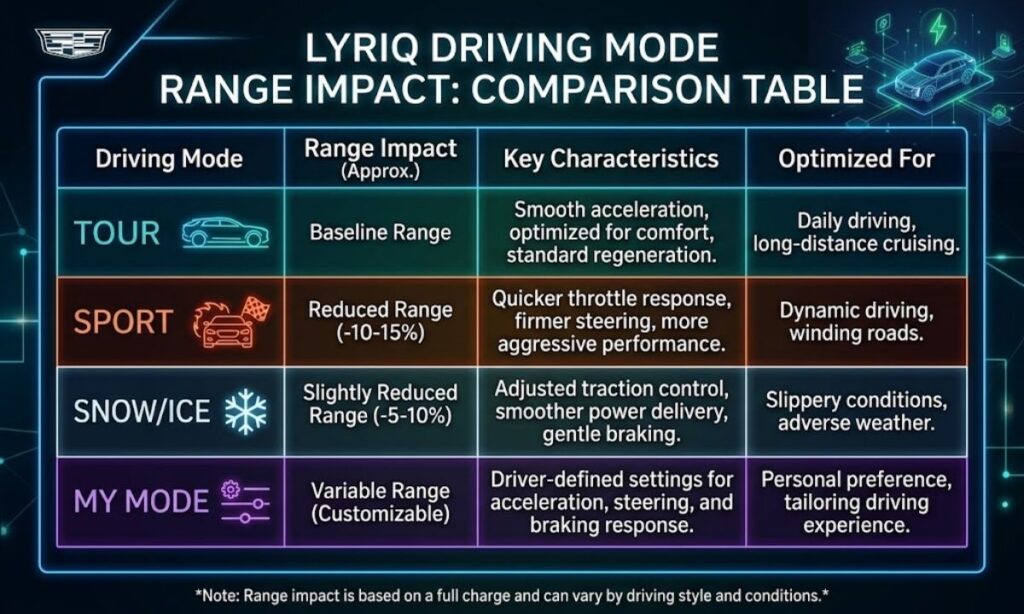
| Driving Mode | Typical Use Case | Relative Efficiency | Estimated Range Impact vs. Tour |
|---|---|---|---|
| Tour Mode | Daily commuting, errands | Highest | Baseline |
| Sport Mode | Spirited or highway driving | Lower | -10% to -20% (aggressive use) |
| Snow/Ice Mode | Icy or snowy roads | Moderate | -5% (mode) plus cold-weather losses |
| My Mode | Personalized driving | Variable | Depends on configuration |
LYRIQ Driving Mode Range Impact — Comparison
Numbers aside, here’s the practical way to think about picking a mode day to day.
If you’re heading to work on familiar roads with no rush, Tour Mode is the obvious pick. It’s comfortable, it’s efficient, and it doesn’t ask anything extra of the battery.
If you’re merging onto a highway full of aggressive traffic, or you just want a livelier feel on a weekend drive, Sport Mode earns its keep. Just know you’re paying for that fun in range.
Snow/Ice Mode isn’t really a choice about efficiency at all, it’s a choice about staying on the road. When conditions call for it, use it without hesitation. My Mode sits in between, letting you pick your own priorities once you’ve figured out what actually matters to you.
A useful mental shortcut: ask yourself what today’s drive actually needs. Commuting needs efficiency. A canyon road needs response. Ice needs restraint. Match the mode to the moment instead of picking one favorite and sticking with it regardless of conditions, and you’ll naturally land on better numbers without thinking too hard about it.
Practical Considerations
A few habits make a bigger difference than obsessing over which mode icon is lit up.
Tire pressure matters more than most owners realize. Underinflated tires increase rolling resistance, which quietly eats into range regardless of which driving mode you’ve selected.
Route planning also plays a role. Knowing where charging stations sit along a longer trip removes range anxiety, letting you drive naturally instead of babying the accelerator the whole way.
And honestly, smoothness beats mode selection almost every time. A smooth driver in Sport Mode can easily out-efficient a jerky, stop-start driver stuck in Tour.
There’s also a cost angle worth mentioning, since range and money are connected in most owners’ minds. Every extra 10 percent of energy consumption from aggressive Sport Mode driving translates directly into extra charging costs over a year of ownership. It’s not a huge number on any single trip, but it adds up the same way any small daily habit does.
Cargo and passenger weight play a smaller but real role too. A fully loaded LYRIQ on a family road trip will use somewhat more energy than the same car driving solo, regardless of mode. It’s rarely enough to change your plans, but it’s worth factoring in when you’re calculating exactly how far a single charge will take you.
Regenerative Braking and One-Pedal Driving’s Role in Range
No conversation about LYRIQ range is complete without regen, since it’s arguably a bigger lever than driving mode selection.
How Regen Braking Recovers Energy
Regenerative braking strength works by using the electric motor as a generator whenever you lift off the accelerator or apply the brakes. Instead of that kinetic energy turning into wasted heat, it flows back into the battery.
Cadillac’s Regen On Demand paddle lets you control this manually, pulling it toward you for stronger deceleration and more energy recovery. Combine that with One-Pedal Driving, and you can handle most stop-and-go situations without ever touching the brake pedal.
This system works the same way across Tour, Sport, and Snow/Ice, so you get the efficiency benefit no matter which mode you’re in.
Cadillac’s blended braking system is worth a quick mention too, since it explains why the LYRIQ feels so natural compared to older EVs. Whether you’re using the brake pedal, the Regen On Demand paddle, or One-Pedal Driving, the car blends regen and friction braking seamlessly underneath. You don’t have to think about which system is doing the work, it just happens.
There’s one small catch worth knowing. When your battery is nearly full or extremely cold, regenerative braking capacity drops temporarily, and the car leans more on friction brakes instead. It’s a minor detail, but it explains why regen can feel slightly weaker right after a full charge on a cold morning.
One-Pedal Driving in City vs. Highway Use
One-Pedal Driving shines brightest in city driving efficiency scenarios. Constant stopping and starting means constant opportunities to recapture energy instead of losing it to friction brakes.
On the highway, its benefit shrinks. You’re maintaining speed more than stopping, so there’s simply less braking energy to recover. That doesn’t mean it’s useless up there, just less dramatic.
Some owners find One-Pedal Driving takes a little getting used to. Give it a week of city commuting before deciding it’s not for you, most people adjust faster than expected.
If you’ve driven a car with a manual transmission before, One-Pedal Driving might click faster than you’d think. It’s a similar sensation to engine braking, lift off and the car slows itself, except here that “engine braking” is quietly refilling your battery instead of wasting energy as heat.
Not every owner ends up loving it, and that’s fine too. You can use the Regen On Demand paddle on its own without full One-Pedal Driving engaged, which gives you a middle ground between traditional coasting and full one-foot control.
How LYRIQ Range Varies by Driving Environment
Driving mode is one input. Where you’re actually driving is arguably a bigger one.
City Driving
Stop-and-go traffic sounds like it should hurt efficiency, and in gas cars it does. In the LYRIQ, frequent braking actually plays to the battery’s advantage thanks to regen recapturing energy at every stop.
Lower speeds also mean less wind resistance fighting the SUV. City driving, done smoothly, is often where the LYRIQ posts its best efficiency numbers.
It sounds backward compared to gas cars, where city driving is usually the efficiency killer. EVs flip that script entirely. The one thing that makes city driving less pleasant for a combustion engine, constant stopping, is exactly what an electric motor and regen system are built to take advantage of.
Highway Driving
Highway speed is the real range killer, more than any driving mode setting. Aerodynamic drag increases sharply as speed climbs, and that relationship isn’t linear, it gets worse fast above 65-70 mph.
Cruising at 80 mph will noticeably shrink your range compared to 65 mph, regardless of whether you’re in Tour or Sport. If you’re planning a long road trip, dialing back your cruising speed by even 5-10 mph pays off more than any mode switch.
Think of pushing your SUV through the air at highway speed like pushing your open palm against water while swimming. Push a little faster, and the resistance doesn’t just go up a little, it goes up a lot. That’s the physics working against you every time you nudge cruise control higher.
This is exactly why a heavy-footed driver in Tour Mode on the interstate can still see worse numbers than a relaxed driver in Sport Mode sticking to city streets. Speed, not mode, is doing most of the talking at highway pace.
Mountain/Elevation Driving
Elevation changes hit range from both directions. Uphill driving demands sustained power output, draining the battery faster than flat terrain ever would.
The upside is downhill regenerative braking, which recovers a meaningful chunk of that energy back on the way down. It won’t fully offset the climb, but it softens the blow considerably.
Mountain routes are a good example of why total trip range matters more than any single segment’s numbers.
If you’re planning a mountain trip, don’t panic at your remaining range percentage halfway up a climb. That number often looks worse than reality, since it hasn’t accounted for the descent still coming and the energy you’re about to recover on the way down.
Additional Factors Affecting Range and Battery Usage in the LYRIQ
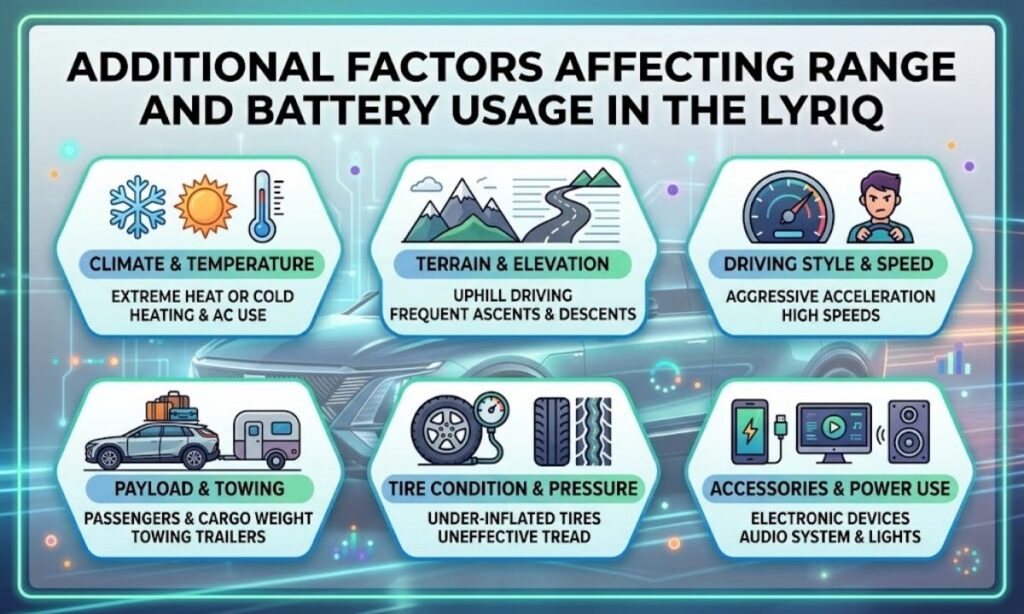
Beyond mode and terrain, a handful of everyday factors quietly shape your real numbers.
1. Driving Style: The Hidden Influence on Efficiency
Your foot matters more than your mode selector. A gentle driver in Sport Mode can beat an aggressive driver in Tour Mode without much effort.
Smooth acceleration, early braking, and anticipating traffic all reduce the peaks in power demand that hurt efficiency the most. It’s less about driving slowly and more about driving predictably.
Watching traffic a few cars ahead instead of reacting to the car directly in front gives you time to ease off naturally instead of stomping the brakes at the last second. That single habit alone can shift your efficiency more than any mode ever will.
2. Speed and Highway Driving
We touched on this above, but it deserves repeating since it’s one of the biggest single levers you control. Every extra 5 mph above 65 costs you noticeably in real-world driving conditions.
Cruise control set a touch lower on a long trip is one of the simplest, least glamorous ways to extend your total range. It won’t feel exciting, but it works.
3. Environmental Conditions and Temperature
Cold-weather battery performance drops due to basic battery chemistry, and there’s not much you can do about physics. Heat is more forgiving on the battery itself, though running the AC hard still pulls energy.
Extreme heat brings its own smaller penalty too, mostly from air conditioning load rather than the battery struggling. It’s a much gentler hit than what winter delivers, but it’s not zero.
Seat heaters and heated steering wheels, when available, are worth using instead of blasting the cabin heater on cold mornings. Warming the person rather than the whole cabin is a genuinely useful cold-weather battery performance trick that a lot of EV owners eventually discover.
4. Terrain and Elevation Changes
Hills, mountain passes, and even a hilly commute all add variability that flat-ground EPA testing simply doesn’t capture.
If your regular commute includes a steady climb one direction and a descent the other, you’ll likely notice asymmetric range numbers depending on which way you’re driving. That’s completely normal and not a sign anything’s wrong with the vehicle.
Does Driving Mode Affect Battery Health or Degradation?
This is a fair worry, and the answer should put most owners at ease.
Selecting Sport Mode occasionally, or even often, does not meaningfully accelerate battery degradation. EV battery longevity is driven far more by charging habits, heat exposure, and total charge cycles than by which drive mode you prefer.
That said, consistently hammering the accelerator in Sport Mode does generate more heat in the battery and drivetrain over time. Cadillac’s thermal management system is built to handle this, so it’s not something to lose sleep over during normal ownership.
The bigger levers for long-term battery health live elsewhere, which brings us to the next section.
It’s a bit like comparing how you drive a car to how many miles you put on it overall. Aggressive driving on any given day is a minor factor. Total mileage, charging patterns, and climate exposure over years are what actually shape long-term outcomes. Sport Mode is closer to the first category than the second.
Optimizing Battery Usage for Long-Term Health
If you actually want to protect your battery for the long haul, here’s where to focus your energy, pun intended.
1. Charging Habits
Daily charging to 80% is the standard recommendation across the EV industry, and Cadillac echoes it too. Save 100% charging for road trips only, since topping off fully on a regular basis adds unnecessary strain.
Frequent fast charging isn’t ideal either. It’s fine occasionally, but relying on DC fast charging for every top-up will wear on the pack faster than home Level 2 charging.
Cadillac’s own guidance backs this up directly. Charging to 80 percent for daily use leaves headroom in the battery for regenerative braking to actually do its job, since a completely full pack has nowhere to store that recaptured energy. It’s a small detail that a lot of new owners overlook.
2. Battery Preconditioning
Battery preconditioning warms the pack before a planned DC fast charging stop, which dramatically improves charging efficiency in cold weather. Most owners simply route to a fast charger through the nav system and let the car handle it automatically.
Skipping this step in winter means slower charging and more strain on a cold battery, so it’s worth building into your routine.
The nice part is you barely have to think about it. Route to a DC fast charger through the LYRIQ’s built-in navigation, and preconditioning kicks in automatically as you approach. No manual settings to remember, no extra button to press.
3. Regular Maintenance
Basic upkeep like proper tire pressure, software updates, and following Cadillac’s service schedule all contribute to consistent battery performance over years of ownership.
None of this is glamorous, but it’s the boring stuff that actually protects your investment.
If there’s one theme running through all three of these habits, it’s this: the battery rewards consistency far more than it punishes the occasional Sport Mode joyride. Build good baseline habits, and you’ll have plenty of room left over to enjoy the fun stuff.
How to Switch Driving Modes on the LYRIQ
If you’re new to the LYRIQ, changing modes takes seconds once you know where to look.
- Find the Driver Mode Control button near the steering wheel, or open the menu on the center touchscreen
- Select Tour, Sport, Snow/Ice, or My Mode
- The vehicle blends into the new calibration within a second or two, no need to stop
One thing worth knowing: Tour and My Mode typically carry over the next time you start the car, but Sport and Snow/Ice often reset to Tour after a restart. Don’t be surprised if your LYRIQ “forgets” Sport Mode overnight.
This isn’t a glitch, it’s a deliberate safety choice. Cadillac doesn’t want a driver hopping in for a routine errand to accidentally inherit yesterday’s spirited Sport Mode settings without realizing it. Defaulting back to Tour keeps the baseline predictable every time you start the car.
LYRIQ-V and Velocity Max Mode: What’s Different
The performance-focused LYRIQ-V adds a fifth mode called Velocity Max on top of the standard four.
This setting unlocks the vehicle’s full 615 horsepower and sharpens everything Sport Mode already touches, just further. It’s built for occasional spirited driving, not daily use.
Velocity Max drains the battery faster than any other setting on the LYRIQ lineup, so treat it as an occasional treat rather than your default. Most LYRIQ-V owners save it for open roads and empty on-ramps.
If you’re cross-shopping the standard LYRIQ against the V-Series, keep this in mind. The extra performance is real and genuinely exciting, but it comes with a wider range swing between your gentlest and most aggressive driving days. That’s a fair tradeoff for a lot of buyers, just go in with clear expectations.
Common Mistakes LYRIQ Owners Make With Driving Modes
A few habits show up again and again among new owners, and they’re easy to fix once you know about them.
- Leaving the vehicle in Sport Mode for daily commuting, which unnecessarily costs range on trips where quick acceleration isn’t needed
- Forgetting to switch to Snow/Ice Mode before the season’s first cold, icy morning
- Assuming any mode changes the battery’s actual 102 kWh capacity, it never does
- Never exploring My Mode, and missing out on a setup that could genuinely fit your driving style better
- Overusing Velocity Max on the LYRIQ-V for routine driving
EPA Range vs. Real-World LYRIQ Range — What Actually Explains the Gap
If your dashboard number doesn’t match the window sticker, you’re not imagining things, and you’re definitely not alone.
EPA-estimated range comes from standardized lab testing designed for consistency across every vehicle on the market, not from replicating your actual commute. Real speeds, real weather, real hills, and real traffic all pull that number in different directions.
Speed is usually the single biggest gap-closer or gap-widener. Drive at EPA test speeds (which are lower than most highway traffic) and you’ll get closer to the sticker number. Drive at 80 mph in the cold with the heater blasting, and the gap will feel enormous.
The honest takeaway is that EPA numbers are a useful comparison tool between vehicles, not a promise about your specific drive. Track your own real-world numbers over a few weeks, and you’ll get a far more useful personal baseline than any sticker can offer.
Frequently Asked Questions
Does Sport Mode really reduce my LYRIQ’s range? Not directly. Sport Mode itself doesn’t shrink the battery, but it encourages the kind of aggressive driving that does increase consumption.
Which mode gives the best LYRIQ range? Tour Mode, paired with smooth driving habits and moderate speeds, consistently delivers the closest results to the EPA number.
Does Snow/Ice Mode hurt my range in summer? There’s no reason to use it outside slippery conditions, and using it on dry pavement just adds unnecessary throttle softness without any benefit.
Can I switch modes while driving? Yes. The LYRIQ blends into the new mode within a second or two, no need to stop or shift into park.
Does the LYRIQ’s battery capacity change between modes? No. The 102 kWh pack stays exactly the same in every mode. Only the vehicle’s calibration and power delivery change, never the physical storage capacity.
Is My Mode worth setting up, or should I just stick with the presets? It’s worth the ten minutes it takes to configure. Owners who take the time to dial in My Mode often end up with a setup that fits their actual driving style better than any single factory preset can.
Will using Sport Mode void my battery warranty? No. Normal use of any factory driving mode, including Sport, falls well within expected use and won’t affect your battery’s warranty coverage.
You can also checkout this article as well 20 Inches Explained: 7 Everyday Size Comparisons
Conclusion
So, do the driving modes in the Cadillac LYRIQ offer different ranges or battery usages? Yes, but indirectly, and that distinction matters.
Tour Mode stretches your 102 kWh pack the furthest for everyday driving. Sport Mode trades some of that range for genuine driving enjoyment. Snow/Ice Mode spends a small amount of efficiency to buy a lot of winter safety. My Mode simply hands you the dials and lets you decide the tradeoff yourself.
The mode button is a tool, not a magic switch. Pair smart mode selection with steady highway speeds, sensible charging habits, and regular use of regenerative braking, and your LYRIQ will reward you with numbers that make the window sticker look honest.
At the end of the day, this isn’t really about memorizing percentages or treating your battery gauge like a scoreboard. It’s about understanding your car well enough to make small, easy choices that add up. Pick Tour for the daily grind, reach for Sport when you actually want it, trust Snow/Ice when the roads turn against you, and let My Mode become whatever fits you best over time. Drive that way, and the range question mostly takes care of itself.

Jaxon is a content writer and SEO specialist with 4 years of professional experience in creating engaging, research-driven articles.He specializes in simplifying complex topics into clear, reader-friendly content that improves user understanding and search visibility.