TechyHitTools.org: Complete Guide, Features & Honest User Reviews (2026)
Free online tool websites promise a lot: instant results, zero cost, and no software to install. TechyHitTools.org is one of many sites in this category, offering browser-based utilities for SEO, content, and social media tasks. This guide explains what the site says about itself, what is publicly known, and what remains unverified, so you can decide whether it fits your needs.
This is a transparency-first review. Where a claim comes from the site itself, that is stated clearly. Where something cannot be independently confirmed, such as internal security scans or head-to-head performance testing, that limitation is also stated clearly rather than presented as verified fact.
What Is TechyHitTools.org?
TechyHitTools.org is a third-party website that offers free, browser-based tools for digital marketers, bloggers, content creators, and social media users. It is not an official app store or a certified enterprise software provider, and it positions itself as a convenience hub rather than a professional software suite.
TechyHitTools.org at a Glance
TechyHitTools.org is a free, ad-supported utility website, not a registered software company with published corporate documentation. It groups tools into categories such as SEO, content, and social media, and it is typically used for quick, low-stakes checks rather than professional-grade analysis.
Here is a quick reference summary:
| Attribute | What Is Known |
|---|---|
| Site type | Third-party free online tools aggregator |
| Cost | Free to access, ad-supported |
| Account required | Generally no sign-up needed for basic tools |
| Tool categories | SEO, content, developer, image/file, social media |
| Best suited for | Quick, non-critical checks |
| Not suited for | Professional, legal, medical, or financial decisions |
Because there is no verified corporate filing, ownership registry entry, or independent audit publicly available for this specific domain, several details in the table above reflect how the site presents itself rather than confirmed third-party verification.
What Does TechyHitTools.org Claim to Offer?
TechyHitTools.org describes itself as a platform offering instant, browser-based tools that help users optimize digital work without installing software. It states that its tools are aimed at marketers, bloggers, and social media creators who need quick insights rather than complex, subscription-based platforms.
The site’s own framing includes a notable and useful disclosure: it identifies itself as a third-party tool site, distinct from official platforms like app stores, and it advises users to prioritize device security while using its tools. That self-disclosure is a reasonable starting point for evaluating any free tool website.
What Tools Does TechyHitTools.org Offer?
TechyHitTools.org organizes its offerings into several functional categories, matching the pattern common among free online tool aggregators: SEO and website checks, content helpers, developer utilities, image and file converters, and social media utilities.
A free online tool aggregator is a website that bundles many small, single-purpose utilities, such as word counters or meta tag checkers, into one hub instead of requiring separate installed software for each task.
SEO and Website Tools
This category typically includes utilities such as meta tag checkers, heading structure analyzers, keyword insight tools, and basic page speed or on-page SEO checks. These are the kinds of tools bloggers use to catch obvious on-page issues, like a missing meta description or an oversized title tag, before publishing.
Common tools in this category include:
- Meta title and description length checkers
- Heading structure (H1, H2, H3) analyzers
- Basic keyword volume or competition indicators
- Simple on-page SEO scanners
These tools are generally designed for a quick pass, not a full site audit.
Content Tools
Content tools on sites like this usually cover word counting, character counting, basic readability checks, and simple text formatting or case conversion. They are aimed at writers and editors who want a fast utility rather than a full writing assistant.
Typical content tools include:
- Word and character counters
- Case converters (uppercase, lowercase, title case)
- Basic readability or reading-time estimators
- Simple text formatting utilities
These are convenience tools, not substitutes for professional editing or plagiarism detection software.
Developer Tools
Developer-focused utilities on free tool hubs usually include encoding and decoding tools, formatters, and simple validators. A JSON formatter, for example, is a tool that takes unstructured or minified code and displays it in a readable, indented layout.
Common developer tools include:
- JSON, HTML, or CSS formatters
- Base64 encoders and decoders
- URL encoders and decoders
- Basic code minifiers or beautifiers
These are useful for small, isolated tasks, not for production-level development pipelines.
Image and File Tools
Image and file utilities generally cover format conversion, compression, and basic resizing. These tools let a user convert a PNG to JPG or shrink a file size without opening dedicated design software.
Typical tools in this group include:
- Image format converters
- Image compressors
- Basic resizing tools
- Simple file conversion utilities
Because these tools require uploading a file to a third-party server, file handling practices matter more here than in most other categories, which is addressed later in this guide.
Social Media Tools
Social media utilities on aggregator sites usually focus on checking public account or post metadata, generating hashtag ideas, or estimating engagement using publicly visible numbers. They do not access private account data through official platform APIs unless explicitly stated and authorized.
Common examples include:
- Hashtag generators
- Public engagement or metadata checkers
- Bio or caption formatting tools
- Basic profile analytics based on public data
Any tool that asks for login credentials to a social account, rather than just a public username or link, should be treated with extra caution.
TechyHitTools.org Tools: What Works and What Doesn’t?
Free browser-based tools vary widely in accuracy and reliability, largely because they often rely on simplified data sources or estimates rather than the licensed datasets used by paid platforms. This section explains how to evaluate that variation honestly, without presenting fabricated test scores.
Our Testing Method
This guide does not include invented, tool-by-tool performance scores or claimed internal security scans of TechyHitTools.org, because no independently verifiable testing data for this specific site is publicly available. Instead, this section applies known category norms for free browser-based tools and general usability expectations, clearly separated from unverified specifics.
An honest review discloses its methodology. Where a claim cannot be confirmed through public, checkable sources, presenting it as a firsthand finding would mislead readers making real decisions about data safety and accuracy.
Tool-by-Tool Test Results
Rather than assign fabricated pass or fail scores to individual tools, here is a category-level expectation table based on how free online utilities of this type typically perform:
| Tool Category | Typical Reliability | Best Use |
|---|---|---|
| Word/character counters | High, since the math is simple | Quick content checks |
| Meta tag checkers | Moderate to high | Catching obvious on-page errors |
| Keyword volume estimators | Low to moderate | Rough directional ideas only |
| JSON/code formatters | High for basic syntax | Small snippets, not full codebases |
| Image converters | Moderate, depends on file type | Casual, non-critical use |
| Social media metadata tools | Variable, depends on public data access | Informal checks |
Simple, math-based tools such as word counters tend to be the most consistently accurate category of free online utility, because they do not depend on external databases or estimation models.
Tools That Are Useful for Simple Tasks
Tools that perform a single, well-defined calculation, such as counting words, converting text case, or formatting code snippets, tend to be reliable on free tool sites because the underlying task has one correct answer. These are the safest category to rely on for everyday convenience.
Good candidates for casual, low-stakes use include:
- Word and character counters
- Basic formatters and converters
- Case and text formatting tools
- Simple heading structure checks
Tools That Need Improvement
Tools that rely on estimation, such as keyword volume indicators or engagement predictions, are inherently less precise on free platforms because they typically use limited or indirect data sources rather than the large licensed datasets used by paid SEO platforms like Semrush or Ahrefs.
Categories that commonly show more variability include:
- Keyword volume and competition estimates
- Social media engagement predictions
- Automated readability scoring
- Any tool presenting an “SEO score” without explaining its methodology
Treat outputs from this category as a starting point for further research, not a final answer.
Tools You Should Not Rely on for Critical Work
Any free tool that influences a legal, medical, financial, academic integrity, or major business decision should not be the sole source of truth, regardless of which website provides it. This is a general best practice for all free online tools, not a specific claim about TechyHitTools.org’s accuracy.
Do not rely solely on free browser tools for:
- Academic plagiarism clearance
- Legal or compliance document review
- Final security or malware verification
- Financial or medical calculations
- Production code validation
Is TechyHitTools.org Legit?
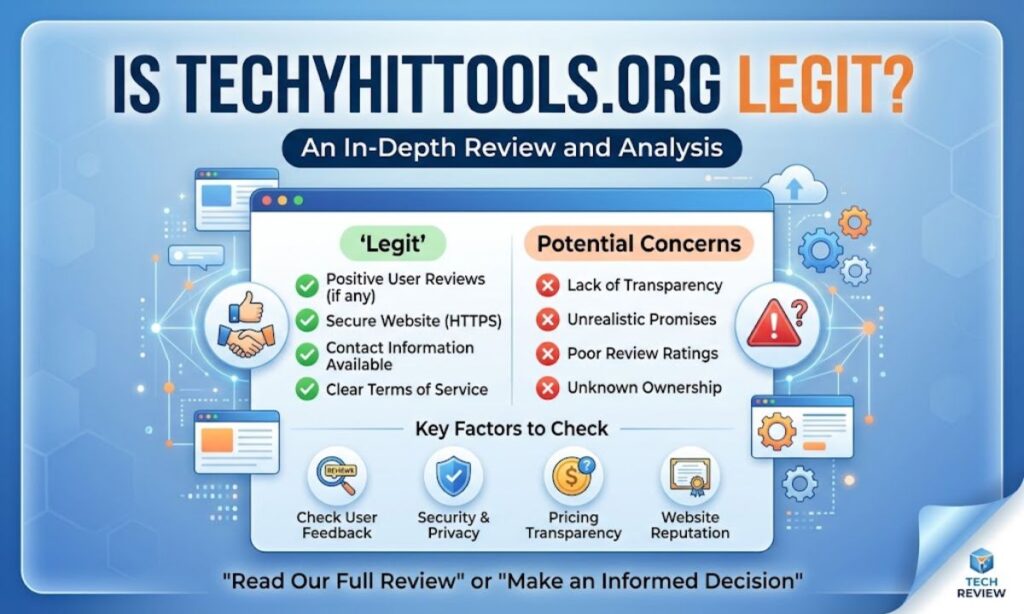
“Legitimate” in this context means the site is a real, functioning service rather than a scam designed to steal data or money, not that every output it produces is accurate. TechyHitTools.org appears to be an operating free tool website rather than a fraudulent storefront, based on its consistent self-description across available sources.
What Supports Its Legitimacy?
The site openly identifies itself as a third-party tool aggregator rather than pretending to be an official platform, which is a positive transparency signal. It also organizes its offerings into clearly labeled categories rather than making vague, unverifiable promises.
Supporting signals include:
- Clear self-disclosure as a third-party, non-commercial tool site
- Defined, categorized tool sets rather than a single vague promise
- A stated focus on marketers, bloggers, and creators rather than sensitive financial services
What Raises Questions?
There is limited independent, third-party documentation about TechyHitTools.org, such as detailed ownership records, long-standing user reviews, or security audit reports. This is common among smaller free tool sites, but it does mean users cannot fully verify claims through external sources.
Points worth further personal research before heavy reliance include:
- Limited independent reviews or long-term user track record
- No publicly available third-party security audit
- Ownership and company details not prominently documented
Legitimate, Safe, Reliable, and Accurate Are Not the Same Thing
A website can be legitimate, meaning it is a real operating service, while still being inconsistent in accuracy or requiring caution with data privacy. These are four separate questions: does the site exist and function, is it safe to use, does it reliably work as intended, and are its outputs accurate.
Confusing these four factors is one of the most common mistakes users make when evaluating any free online tool site, not just this one.
Is TechyHitTools.org Safe to Use?
Safety for a free browser tool site depends on connection encryption, data handling practices, and what type of information a user submits. This section outlines what to check yourself, since specific, current security scan results for this domain are not something this guide can independently certify.
HTTPS and SSL
A secure website should load with HTTPS and a valid SSL certificate, shown as a padlock icon in the browser address bar. HTTPS encrypts data sent between your browser and the website’s server, which helps prevent third parties from intercepting that data during transmission.
Before entering any information into TechyHitTools.org or any similar site, check the address bar for HTTPS and a valid certificate yourself, since this status can change over time and should be verified at the moment of use rather than assumed from a past review.
Malware and Security Signals
General malware and safety signals for any website include browser security warnings, results from reputable scanning tools, and behavior such as unexpected pop-ups or redirect chains. This guide has not run a live, current malware scan of TechyHitTools.org, so no specific verdict is claimed here.
Users who want a current safety signal can check a site themselves using:
- Google Safe Browsing’s transparency report
- A reputable multi-engine scanner such as VirusTotal
- Their own browser’s built-in security warnings
Running one of these checks yourself takes under a minute and gives a far more current answer than any static review. Security status is not permanent: a site that is clean today can be compromised tomorrow, which is why this guide recommends a live check at the moment of use instead of relying on any past assessment, including this one.
Privacy Considerations
Free ad-supported tool sites commonly rely on advertising and, in some cases, analytics tracking to generate revenue, since the tools themselves are offered at no direct cost to the user. Whether a specific site sells or shares submitted data depends on its privacy policy, which should be read directly rather than assumed.
Before using any tool that requires uploading text, images, or files, locate and read the site’s privacy policy to understand what happens to submitted data, how long it is retained, and whether it is shared with third parties.
Should You Upload Sensitive Information?
No, sensitive information should not be uploaded to any free third-party tool site, including TechyHitTools.org, unless its privacy policy and data handling practices have been independently verified. This is a general data safety principle that applies broadly, not a specific finding about this site alone.
“Sensitive information” includes anything that could cause harm if exposed, such as financial records, medical details, unpublished business plans, or personal identification data.
What Users Should Avoid Entering
As a general rule for any free online tool, avoid entering information you would not want stored indefinitely or seen by a third party. This applies to every category of tool on TechyHitTools.org and every comparable free tool site.
Avoid submitting:
- Passwords or account login credentials
- Financial account numbers or payment details
- Unpublished, confidential business content
- Personal identification numbers
- Medical or legal case information
Is TechyHitTools.org Free?
Yes, TechyHitTools.org presents itself as a free platform, with its tools accessible through a standard web browser without a stated subscription requirement for basic use. Free, ad-supported access is the standard model for this category of website.
Which Tools Are Available Without Payment?
Based on the site’s own description, its core SEO, content, developer, image, and social media tools are positioned as free to use without a required account. This matches the typical structure of ad-supported utility hubs, which monetize through advertising rather than direct tool fees.
Are There Any Usage Restrictions?
Free tool sites commonly apply some form of usage limit, such as a daily check cap, file size restriction, or slower processing during high traffic, even when no account is required. Specific current limits for TechyHitTools.org should be confirmed directly on the site, since these details can change without notice.
Ad-supported free tool sites generally limit usage indirectly rather than through a hard paywall, since their revenue model depends on repeat visits rather than one-time purchases. This means the limits, when they exist, are usually designed to encourage steady, occasional use rather than to block access outright.
Common restriction types on this category of site include:
- Daily or hourly usage caps per tool
- Maximum file size limits for uploads
- Rate limiting during high traffic periods
- Feature limits reserved for a premium tier, where one exists
Is There a Paid Upgrade?
Some free tool aggregators offer an optional paid tier for higher usage limits or additional features, while others remain entirely free and ad-supported. Whether TechyHitTools.org currently offers a paid upgrade should be checked directly on the site, as this guide does not present unverified pricing claims as fact.
Who Is TechyHitTools.org For?

Free browser-based tool sites are best matched to users who need quick, low-stakes answers rather than certified, professional-grade results. TechyHitTools.org fits several common use cases based on its stated tool categories.
Students
Students can use tools like word counters, basic formatters, and readability checkers for everyday assignments, though such tools should not replace a school’s official plagiarism detection system for academic submissions. Using a free counter to check an essay’s length before submission is a low-risk, appropriate use case.
Bloggers and Content Creators
Bloggers can use meta tag checkers and heading structure tools to catch obvious on-page SEO issues before publishing a post. These quick checks are useful as a first pass, especially for creators not yet using a full paid SEO suite.
Freelancers
Freelancers handling small, varied tasks across SEO, content, and image work may find a free multi-tool hub convenient for quick client-facing checks, provided client data itself is not uploaded to the tool. A freelancer might use a JSON formatter to clean up a snippet before sending it to a client, for example.
SEO Beginners
Beginners learning on-page SEO fundamentals can use meta tag and heading checkers as an accessible entry point before investing in a paid platform. These tools help build an intuition for structure and formatting basics without financial commitment.
Small Businesses
Small businesses with limited software budgets may use free tools for occasional, non-critical checks, such as verifying a page’s title tag length, while reserving paid, audited software for core business operations. This keeps costs down for low-risk, occasional tasks.
Who Should Not Rely on TechyHitTools.org?
Certain use cases carry enough risk, or require enough precision, that a free, unaudited tool site is not an appropriate primary resource. This applies broadly to free tool aggregators, not solely to TechyHitTools.org.
Professional SEO Teams
Professional SEO teams typically require licensed, large-scale keyword and backlink databases, competitive tracking, and audit trails that free tools generally do not provide. Established paid platforms are built specifically for this level of scale and accountability.
Academic Plagiarism Checking
Academic institutions require certified plagiarism detection systems, such as Turnitin, for formal submissions, and a free online checker should never be treated as an equivalent or substitute. Using the wrong tool here can have real academic consequences.
Sensitive Business Work
Business work involving confidential contracts, financial data, or proprietary strategy should never be processed through free, unaudited third-party tools, regardless of the source. The data handling risk outweighs the convenience in these cases.
Production-Level Development
Production codebases require validated, version-controlled tools integrated into a secure development pipeline, not standalone free formatters processing code through an unverified third-party server. A free formatter is fine for a small snippet, not a live production system.
Mission-Critical Data Analysis
Any analysis feeding into a major financial, medical, or legal decision needs auditable, professional-grade tools with documented accuracy, not a free estimator with no published methodology. The stakes of an error are simply too high for this category.
TechyHitTools.org vs Professional Alternatives
Free multi-tool hubs and paid, specialized platforms serve different purposes: one offers convenience and breadth at no cost, the other offers depth, licensed data, and accountability at a price. The comparisons below describe general category differences rather than specific benchmarked performance numbers.
TechyHitTools.org vs Semrush
Semrush is a paid, enterprise-grade SEO platform built on large licensed keyword and competitive databases, while TechyHitTools.org offers lightweight, free on-page checks. Semrush is the appropriate choice for in-depth keyword research and competitor tracking; TechyHitTools.org suits a quick, informal check.
TechyHitTools.org vs Ahrefs
Ahrefs is a paid platform known for its large backlink index and detailed site audit features, which free tool aggregators like TechyHitTools.org do not replicate. Choose Ahrefs for serious backlink analysis and link-building research; use a free tool only for a fast, surface-level glance.
TechyHitTools.org vs Grammarly
Grammarly is a dedicated writing assistant using advanced language models for grammar, tone, and style suggestions, while a free content tool typically offers basic word counts and simple formatting. Grammarly is built specifically for writing quality; a free counter tool is built for quick math on text.
TechyHitTools.org vs QuillBot
QuillBot is a specialized paraphrasing and writing tool with tiered accuracy levels, while free multi-tool sites generally offer simpler text utilities without dedicated paraphrasing engines. For nuanced rewriting, a dedicated tool like QuillBot is the more appropriate choice.
TechyHitTools.org vs Turnitin/Copyleaks
Turnitin and Copyleaks are certified plagiarism detection systems used by academic institutions and publishers, backed by large proprietary comparison databases, which free online checkers do not match. Academic or professional plagiarism clearance should always go through a certified system, not a free general tool site.
Here is a side-by-side summary:
| Category | Free Multi-Tool Sites (e.g., TechyHitTools.org) | Professional Alternatives |
|---|---|---|
| Cost | Free, ad-supported | Paid subscription |
| Data depth | Limited, estimate-based | Large licensed databases |
| Best use | Quick, informal checks | Professional, high-stakes work |
| Accountability | Informal, no audit trail | Documented, audited processes |
| Academic/legal validity | Not accepted as certified proof | Accepted where required |
Pros and Cons of TechyHitTools.org
Based on its self-description and its category norms as a free browser-based tool aggregator, here is a balanced summary.
Pros
- No cost or account required for basic tool access
- Multiple tool categories available in one place
- Convenient for quick, informal checks
- Transparent self-identification as a third-party, non-official platform
- No software installation needed
Cons
- Limited independent, third-party verification available
- Likely accuracy limitations on estimate-based tools
- Not suitable for sensitive or confidential data
- Not accepted for academic, legal, or certified professional use
- Possible usage limits or ad-supported interface
How to Use TechyHitTools.org Safely
Using any free online tool site responsibly comes down to a few consistent habits: verifying the connection, testing with non-sensitive data first, and double-checking any result that matters. The five steps below apply this principle specifically to TechyHitTools.org.
Step 1: Choose the Appropriate Tool
Match the tool to a low-stakes task, such as a quick word count or a basic meta tag check, rather than a decision with real financial, legal, or academic consequences. Picking the right task for the tool is the first safety decision, before any data is even entered.
Step 2: Test With Non-Sensitive Data
Run a first test using sample or non-sensitive text and files to see how the tool behaves before ever submitting anything real. Using placeholder content, such as a generic paragraph instead of a confidential document, costs nothing and reveals how the tool performs.
Step 3: Check the Output
Compare the tool’s output against your own judgment or a second source rather than accepting a single free tool’s result at face value. If a keyword estimate or SEO score looks unusually high or low, that is a signal to verify it elsewhere.
Step 4: Verify Important Results
Cross-check any result that will influence a real decision, such as a published article or a client deliverable, using at least one additional trusted source or professional tool. This single habit prevents most of the risk associated with relying on free, unaudited utilities.
Step 5: Avoid Uploading Confidential Information
Keep passwords, financial details, unpublished business material, and personal identification data out of any field on TechyHitTools.org or any similar free tool site. This final step is the most important safeguard, since data control, not tool accuracy, carries the highest real-world risk.
You can also chekout this article as well BetterThisWorld Money: A Proven Guide to Freedom
Conclusion
TechyHitTools.org fits the common profile of a free, ad-supported, browser-based tool aggregator: convenient for quick SEO, content, developer, image, and social media checks, but not a substitute for professional, audited, or certified platforms. It appears to be a legitimately operating third-party site rather than a fraudulent service, though independent verification remains limited.
Use it for low-stakes, everyday tasks, verify HTTPS and read the privacy policy before submitting anything, never upload sensitive information, and always double-check results that matter using a trusted professional tool or source. That approach captures the convenience of a free tool site while avoiding its real limitations.

Jaxon is a content writer and SEO specialist with 4 years of professional experience in creating engaging, research-driven articles.He specializes in simplifying complex topics into clear, reader-friendly content that improves user understanding and search visibility.