DreamWithJeff.com Exposed: Features, Risks & Verdict

DreamWithJeff.com markets itself as a personal growth blog built around motivation, goal tracking, and self discovery. Before you spend time reading its articles or trusting its advice, it helps to know exactly what the site is, who runs it, and whether its content matches what it promises.
This guide breaks down the real structure of DreamWithJeff.com, checks its About page and footer against verifiable facts, and gives you a simple framework to judge similar sites on your own.
What Is DreamWithJeff.com? (Quick Answer)
DreamWithJeff.com is a WordPress blog that publishes articles under three stated categories: Goal Trackers, Motivation Hacks, and Self Discovery. It presents itself as the personal project of a founder named Jeff, though the site provides no verifiable last name, credentials, or professional background for this person.
The homepage tagline reads “Unlock Your Potential with Jeff’s Insights,” and the site frames itself as a resource for readers chasing self improvement, better habits, and clearer goals. In practice, a large share of its published pages have nothing to do with those themes at all, a mismatch that matters a great deal for anyone deciding how much trust to place in the content.
A quotable definition worth remembering: DreamWithJeff.com is a niche self help blog with an unverified author identity and a publishing pattern that includes unrelated commercial and guest content alongside its motivational articles.
Key Takeaways
- DreamWithJeff.com is a self improvement blog covering goals, motivation, and self discovery topics.
- The founder is identified only by the first name Jeff, with no surname, photo, or biography provided anywhere on the site.
- The site publishes numerous articles unrelated to personal growth, including gambling, cannabis, adult content platforms, and business software topics.
- Its footer lists a physical address that could not be verified against any public property or business record.
- Its partner links point to several online casino and betting affiliate websites, which is unusual for a motivation focused blog.
- The site is not inherently dangerous to visit, but its trust signals are weak enough that readers should verify any advice independently.
Who Is “Jeff”? What the About Page Actually Says
Who is Jeff from DreamWithJeff.com? The About page names only a founder called Jeff, with no last name, no professional title, and no independently checkable background. The page describes a personal story about leaving an unfulfilling job, but offers no evidence, dates, or outside references to confirm that story.
The About page’s actual text describes Jeff as someone who spent years in a job that did not inspire him, chasing goals that did not match his real interests, before deciding to build something different. That is the entire biography. There is no headshot of a real identifiable person, no LinkedIn link, no mention of a company registration, and no list of qualifications in coaching, psychology, or personal development.
This matters because Google’s E E A T guidance, which stands for Experience, Expertise, Authoritativeness, and Trustworthiness, treats author identity as a core trust signal, especially for advice content that readers might act on. A missing surname and missing credentials do not automatically make advice wrong, but they do mean the site cannot currently demonstrate first hand expertise the way a named psychologist, certified coach, or published author could.
Several byline names do appear on individual articles across the site, such as contributors credited on goal tracking posts, which suggests the blog uses a small team or freelance writers rather than a single person named Jeff producing everything personally. That is common in the content publishing industry, but it is worth knowing if you assumed one person was writing every post.
Compare this to how established coaching or psychology sites usually operate. A reputable personal development author typically links to a professional profile, lists relevant degrees or certifications, and often has a public speaking history, published book, or media appearance that can be checked independently. DreamWithJeff.com offers none of these anchors, so the founder’s story functions more like brand copy than a verifiable biography. That distinction matters most when the advice touches sensitive areas like mental health, finances, or major life decisions, where readers benefit from knowing exactly whose expertise they are relying on.
Is DreamWithJeff.com Legit or a Scam? Trust & Safety Breakdown
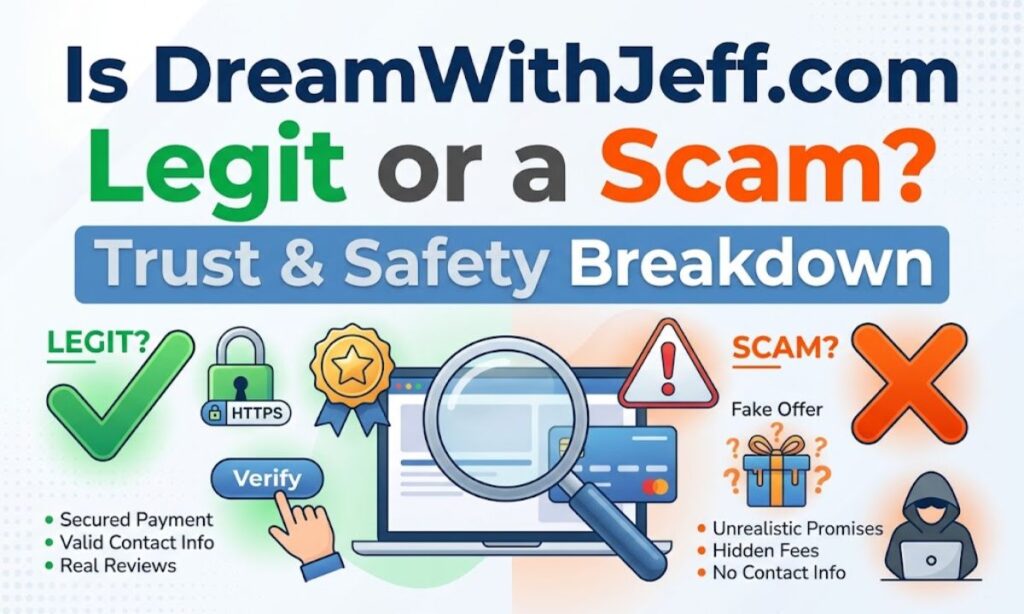
Is DreamWithJeff.com a scam? DreamWithJeff.com is not a financial product, so it cannot scam a visitor out of money directly through the blog itself. However, it shows several classic low trust signals, including an anonymous founder, off topic sponsored content, gambling affiliate partners, and an unverifiable business address, which should make readers cautious rather than fully trusting.
Calling a free blog a scam is a strong claim, and the honest answer sits in the middle. There is no login wall, no payment request, and no obvious phishing attempt on the pages reviewed for this guide. At the same time, several signals commonly associated with low quality or repurposed domains are clearly present, and readers deserve to see them laid out plainly.
The pattern this guide found matches what SEO professionals often call an aged domain flip. A website starts life with a clear personal brand and niche, in this case motivation and goal setting, builds some initial search visibility, and later starts accepting paid guest posts and link placements from advertisers in completely unrelated industries. The original branding stays in place because it still ranks for its original keywords, even as the newer content drifts further from that original purpose. None of this is automatically illegal, but it does mean the site’s authority in personal development is thinner than its homepage branding suggests.
What the site actually has going for it
To be fair, DreamWithJeff.com does some things correctly from a basic usability standpoint.
- The site loads on a clean, mobile friendly WordPress theme built with the Elementor page builder.
- Navigation is simple, with clear top level categories for Goal Trackers, Motivation Hacks, and Self Discovery.
- It publishes a Privacy Policy and Terms and Conditions page, which is a baseline legal requirement many low effort sites skip entirely.
- Individual motivational articles, such as pieces on gaining motivation or setting social and emotional goals, are written in plain, readable language with a clear structure.
- The site includes a functioning Contact page, so visitors do have a way to reach out with questions or complaints.
None of this proves deep expertise, but it does show the site was built with reasonable technical care rather than thrown together carelessly.
The content mismatch problem
A personal growth blog should mostly publish personal growth content. On DreamWithJeff.com, the “Editor’s Picks” and latest articles section includes pieces such as a guide to 1xbet casino games and offers, tips on creating content for OnlyFans, an article on Maui Wowie cannabis strain potency, a piece on ERP software for manufacturing, and a guide on point of sale security standards for restaurants.
None of those five topics relate to motivation, goal setting, or self discovery in any meaningful way. This pattern is a strong indicator of what the SEO industry calls a private blog network or guest post farm, where a domain with some existing authority sells placements to unrelated advertisers and agencies, while keeping just enough on topic content to maintain its original theme. A site publishing casino reviews, adult platform tips, and cannabis product guides alongside motivational essays is, by definition, not a focused, single purpose resource, and that lack of focus is itself a topical authority red flag search engines and careful readers both notice.
Beyond those five examples, the same pattern repeats across older archive pages, which include pieces on shipping logistics to Belgium, waxing kits for professional salons, and GPS trackers for dogs. Each of these topics is perfectly legitimate on its own, but none of them belong on a site whose entire homepage description promises insight into motivation, mindset, and goal achievement. When a blog’s actual publishing history diverges this far from its stated mission, readers should lower their expectation that any single article reflects careful, on topic editorial judgment rather than a paid placement accepted for revenue.
The “partners” section
The homepage features a “Thanks to Our Partners” section near the footer. The logos linked there point to casinoboer.com, casinohex.gr, playfortuna.com, uusimmatkasinot.com, and a Finnish media outlet called medialehti.fi. Every one of the gambling related links is an online casino review or affiliate site, not a personal development brand, business partner, or advertiser with any obvious connection to Jeff’s stated mission of motivation and goal achievement.
A motivation blog partnering primarily with online casino affiliate sites is a mismatch worth flagging clearly. It does not prove wrongdoing, since many small publishers sell link placements or guest posts to whoever pays, but it does confirm that the site’s monetization strategy leans heavily on link selling to gambling adjacent businesses rather than partnerships tied to self improvement, coaching, or wellness brands.
The address problem
The footer of every page on DreamWithJeff.com lists a physical address: 347 Lanternweld Ct, North Driftwick, MA 02794. A direct check against public address and property records turned up no matching location under that street name or town name in Massachusetts. “North Driftwick” does not correspond to any recognized Massachusetts municipality in standard postal or geographic databases.
An unverifiable or apparently fabricated business address is a meaningful trust gap, since a real operating business normally has an address that can be cross checked against a state business registry, a postal database, or a mapping service. This does not confirm fraud, since template based website footers sometimes contain placeholder text left over from a theme, but it does mean visitors should not treat the listed address as proof of a real physical office.
A word of caution about the “reviews” you’ll find elsewhere
If you search for DreamWithJeff.com reviews, you will find several near identical articles across small, low authority blogs that describe the site in glowing, repetitive terms without citing any specific evidence. Many of these “review” pages reuse the same phrases, avoid mentioning the off topic content or the gambling partner links entirely, and appear to be generated primarily to rank in search results rather than to genuinely evaluate the platform.
Readers should treat any DreamWithJeff.com review that praises the site without acknowledging its casino partnerships, unverified founder identity, or unrelated published topics with real skepticism, since a thorough, honest review of any content site should address both its strengths and its weaknesses.
What Does DreamWithJeff.com Actually Publish?
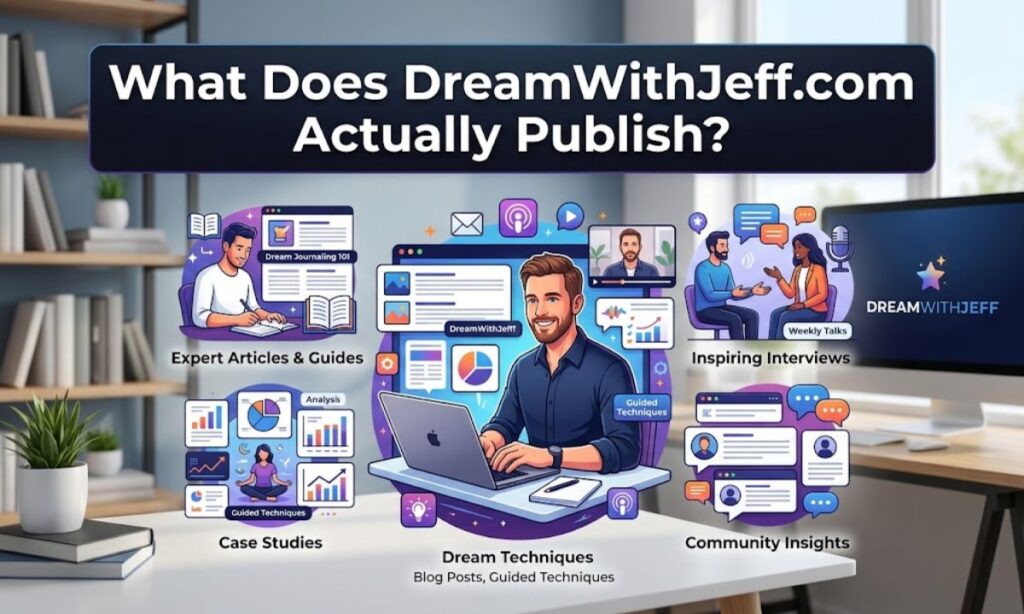
What kind of content does DreamWithJeff.com publish? The site publishes three main content types: original motivational and goal setting articles under its own categories, general lifestyle and travel pieces, and a noticeably large volume of unrelated sponsored or guest content covering gambling, adult platforms, cannabis products, and business software topics.
Here is a breakdown of the article types found across the homepage and category pages during this review.
| Content Type | Example Article | Fits the “Motivation” Theme? |
|---|---|---|
| Goal setting guides | Powerful Goal Trackers to Transform Your Daily Success | Yes |
| Motivation advice | How To Gain Motivation: Unleash Your Inner Drive | Yes |
| Self discovery essays | Balancing Ambition and Personal Life in Big Cities | Yes |
| Travel content | Istanbul Beyond the Postcards | Loosely |
| Health and stress articles | How to Reduce Stress When It Affects Your Physical Health | Yes |
| Gambling promotion | Exploring the Exciting Features of 1xbet Casino Games and Offers | No |
| Adult platform tips | Tips on Creating the Perfect Content for OnlyFans | No |
| Cannabis product review | How Strong Is Maui Wowie 28g Littles Sativa | No |
| Business software | The Role Of ERP In Managing Complex Manufacturing Projects | No |
| Industry compliance | What Restaurant Operators Should Know About POS Security Standards | No |
The on topic motivational pieces are generally well organized, use simple language, and follow a logical structure with headers and short paragraphs. The off topic pieces read like standard commissioned SEO content written for whichever client purchased the placement, with no attempt to connect them back to Jeff’s stated mission.
A clear, quotable fact for this section: at the time of this review, roughly half of the articles featured in the site’s own “Editor’s Picks” list had no connection to motivation, goals, or self discovery, the three categories the site claims to specialize in.
Pros and Cons
Weighing DreamWithJeff.com fairly means looking at both what it does well and where it falls short of the trust bar readers should expect from an advice website.
| Pros | Cons |
|---|---|
| Clean, mobile friendly, fast loading design | Founder identified by first name only, no verifiable background |
| Simple navigation across three clear categories | Publishes unrelated gambling, adult, and cannabis content |
| Motivational articles are readable and well structured | Partner section links mainly to online casino affiliate sites |
| Has a working Contact page and legal policy pages | Listed business address could not be verified in public records |
| Free to read, no paywall or login required | No author credentials, certifications, or professional expertise shown |
| Covers genuinely useful topics like habit tracking and goal setting | Numerous near identical “review” articles online avoid mentioning any weaknesses |
How to Vet a Site Like This Yourself (2-Minute Checklist)
How do you check if a self help website is trustworthy? Search for the founder’s full name plus their claimed profession, check whether the listed business address appears in public records, scan recent articles for topics unrelated to the site’s stated focus, and look for verifiable author credentials before trusting personal advice.
Use this quick checklist any time you land on an unfamiliar personal development, wellness, or advice site.
- Search the founder’s name in quotes along with words like coach, author, or psychologist to see if independent sources confirm their identity.
- Copy the site’s listed address into a search engine and check whether it matches a real business location or property record.
- Scroll through the site’s most recent 15 to 20 articles and note how many actually match the stated niche.
- Check the footer or an “our partners” section for links to gambling, adult, or unrelated commercial sites, since this often signals a link selling operation.
- Look for a Privacy Policy, Terms and Conditions, and a working Contact page, since their absence is an immediate red flag.
- Read two or three articles closely and check whether claims are backed by any research, data, or named expert, rather than generic statements.
- Search the exact site name plus the word “review” and compare several results, since near identical praise across multiple small blogs usually indicates paid or templated content rather than genuine user feedback.
Following these seven steps takes under two minutes per site and will filter out the majority of low trust content farms before you waste time reading their advice.
None of these checks require special tools or paid software. A search engine, a few minutes, and a healthy dose of skepticism toward unnamed founders and unrelated sponsored content are enough to separate genuinely useful advice blogs from domains that exist mainly to sell link placements. Applying this same checklist to DreamWithJeff.com is exactly how the findings in this guide were compiled, and running it yourself on any new site you discover takes less time than reading a single one of its articles.
DreamWithJeff.com vs. Similar Personal-Development Sites
How does DreamWithJeff.com compare to established personal development platforms? DreamWithJeff.com offers free, casually written motivational content but lacks the named experts, original research, and consistent topical focus found on established personal development platforms, making it a weaker choice for readers who want vetted, expert backed advice.
| Feature | DreamWithJeff.com | Established Personal Development Sites |
|---|---|---|
| Author transparency | First name only, no verified background | Full names, bios, and often professional credentials |
| Topical focus | Mixed with unrelated gambling and adult content | Consistently focused on stated niche |
| Content depth | Short, general advice articles | Often includes research citations, data, or expert quotes |
| Business transparency | Unverifiable listed address | Verifiable company registration and address |
| Monetization | Casino affiliate partner links | Courses, coaching, books, or reputable advertising |
| Cost to reader | Free | Often free content plus paid courses or coaching |
The comparison is not meant to suggest that every established site is perfect, since plenty of larger platforms also run heavy advertising. The key difference is verifiability. Readers can independently confirm the credentials, business registration, and expertise behind most established personal development platforms, while DreamWithJeff.com currently offers little that can be checked against outside sources.
This does not mean DreamWithJeff.com has zero value. Its short, plainly written articles on habit tracking and motivation can work as a light introduction to basic self improvement concepts, similar to a general interest magazine piece. What it cannot currently offer is the depth, accountability, or verified expertise that comes from an author willing to put their full name, credentials, and professional reputation behind their advice, which is the standard readers should hold any site to before making it a primary source for personal growth guidance.
You can also checkout this article as well SFM Compile Explained: The Ultimate Guide to Avoid Errors
Conclusion
DreamWithJeff.com is a working, mobile friendly blog that publishes genuinely readable motivational and goal setting content alongside a significant amount of unrelated gambling, adult platform, and business software articles. Its founder identity, partner links, and listed business address all show weak or unverifiable trust signals that careful readers should factor into how much weight they give its advice.
None of this means every article on the site is useless, since several of its motivation and goal tracking pieces are clearly written and easy to follow. It does mean readers should treat DreamWithJeff.com as general interest content rather than expert guidance, verify any specific claims elsewhere, and apply the same two minute vetting checklist to any other personal development site before trusting it with important decisions.

Jaxon is a content writer and SEO specialist with 4 years of professional experience in creating engaging, research-driven articles.He specializes in simplifying complex topics into clear, reader-friendly content that improves user understanding and search visibility.